Ladki Bahin Nominee Rules: Claiming Money After Death
Losing a loved one is a profound emotional burden. Amidst the grief, families often find themselves navigating a maze of administrative tasks, especially when it comes to government welfare schemes. If a woman in your family was a beneficiary of the Mukhyamantri Majhi Ladki Bahin Yojana and has sadly passed away, you may be wondering what happens to the ₹1,500 monthly installments.
As a senior researcher following Maharashtra’s welfare landscape for years, I have seen many families lose out on rightful dues simply because they didn’t know the specific rules for “Deceased Claims.” In this guide, I will walk you through the official process for claiming pending money and the legal steps every nominee must follow.
The Core Rule: Does the Benefit Continue?
The most important thing to understand is that the Ladki Bahin Yojana is a personal benefit intended to support the living beneficiary.
- Scheme Termination: The monthly financial assistance officially stops upon the death of the beneficiary. The scheme cannot be “transferred” to a daughter, daughter-in-law, or sister under the same application.
- Claimable Dues: Any installments that were already credited to the beneficiary’s bank account before her death, or payments that were “In Process” (disbursed but not yet settled) at the time of her passing, belong to the registered nominee or legal heir.
Step 1: The “Two-Front” Action Plan
To handle this professionally, you must act on two fronts: the bank and the government portal. Many bloggers only mention the bank, but neglecting the portal can lead to legal complications or “Recovery Notices” if the system continues to auto-credit funds after a death.
Front A: The Bank Claim
Since the Ladki Bahin money is sent via Direct Benefit Transfer (DBT) to an Aadhaar-linked account, the funds are governed by the Reserve Bank of India’s (RBI) settlement rules.
- Identify the Nominee: Check the beneficiary’s bank passbook. Under the “Nominee” section, you will see a name. If a name exists, the process is simple.
- Obtain the Death Certificate: This must be the original certificate issued by the Gram Panchayat, municipal corporation, or state health department.
- Fill out Form DA-1: Visit the bank and ask for the Deceased Claim Form (Annexure I-A). This is a standardized form for accounts with a nominee.
- Submission: Submit the form along with a copy of the death certificate and the nominee’s Aadhaar/PAN card. For small amounts typical of this scheme (usually under ₹50,000 balance), banks are instructed to settle claims within 15 to 30 days.
Front B: The Ladki Bahin Portal Update
You must inform the Women and Child Development (WCD) department to stop future payments.
- Visit the Nodal Officer: Contact the local Anganwadi worker or the Gram Sevak.
- Submit a Written Intimation: Provide a simple letter stating the beneficiary’s name, application ID, and date of death, attached with a copy of the death certificate.
- Status Update: They will update the status on the
ladakibahin.maharashtra.gov.inportal to “Closed due to Death.” This ensures the family isn’t flagged for “Ghost Beneficiary” fraud in future audits.
Step 2: What if No Nominee Was Registered?
In many rural areas, accounts were opened in haste without formal nomination. If the beneficiary passed away without naming a nominee, don’t panic.
- For Amounts up to ₹15 Lakh (RBI 2026 Rule): Banks no longer strictly require a court-ordered succession certificate for small balances.
- The Solution: The legal heirs (husband or children) can submit an Indemnity Bond and a Legal Heir Certificate issued by the local Tahsildar or Executive Magistrate. This confirms that you are the rightful claimant to the deceased person’s estate.
Step 3: Crucial Warning on ATM Withdrawals
A common mistake families make is using the deceased beneficiary’s ATM card to withdraw the pending ₹1,500 installments after her death. Avoid this. In the 2026 digital ecosystem, bank systems are increasingly synced with death registries. Withdrawing money from a deceased person’s account without formal bank intimation is considered “unauthorized access.” It is always safer to let the bank transfer the funds to the nominee’s account officially.
Checklist of Required Documents
Before heading to the bank or Setu Kendra, ensure you have this “Folder of Proof” ready:
- Original Death Certificate (plus 3 photocopies).
- Beneficiary’s Bank Passbook and Aadhaar Card.
- Nominee’s Aadhaar card and a canceled check of their own account.
- Ladki Bahin Application ID (found on the Nari Shakti Doot app or portal).
- Self-Declaration (Hamipatra): A simple statement from the nominee claiming they are the rightful receiver of the dues.
Expert Insight: What if the Payment Was “Stuck”?
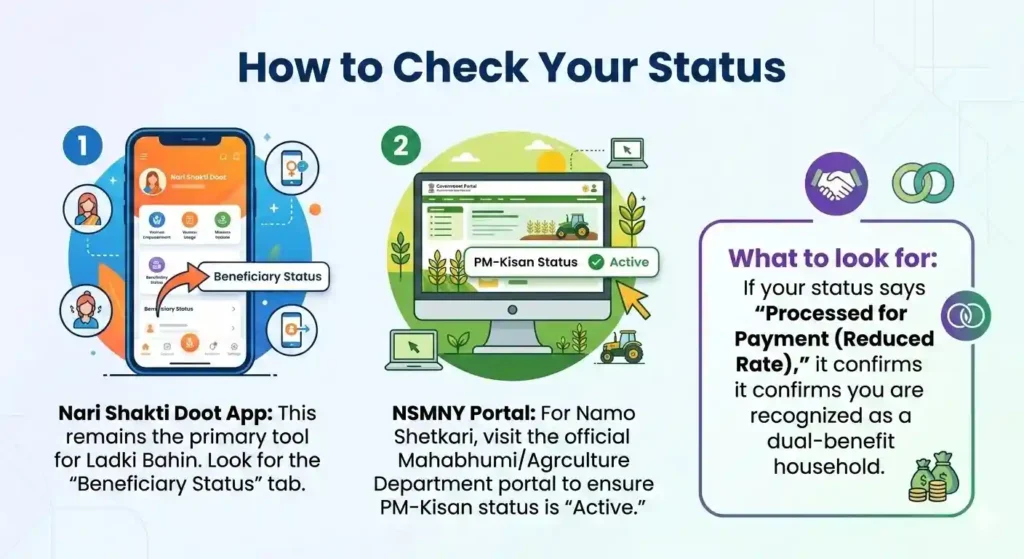
If an installment was “Pending” due to an e-KYC error (a major issue in early 2026) and the beneficiary passed away before it was fixed, the nominee can still claim it. You will need to provide the bank’s “Account Statement” to the local WCD officer to prove the payment was never received, along with the death claim documents.
FAQs
Can I apply for the scheme if I am the daughter of the deceased?
You cannot “take over” her application. You must be between 21 and 65 years old and meet all eligibility criteria (income under ₹2.5 lakh, etc.) to file a fresh application in your own name.
The bank is asking for a “Succession Certificate” for just ₹3,000. Is this legal?
Under the latest RBI 2026 circulars, banks are urged to use a “Simplified Procedure” for small accounts. For amounts under ₹15 lakh without a nominee, they should accept a legal heir affidavit or indemnity bond instead of a costly court certificate.
How do I find out who the nominee is if the passbook is empty?
You can request the bank manager to check the “Customer Master Detail” (CMD) on their system. They can see the nominee name registered during the account opening or the last KYC update.
Will the government ask for the previous 5 months of money back?
No. Any money paid while the beneficiary was alive is hers. Only money deposited after the date of death might be subject to recovery if it was withdrawn by the family without intimation.
Final Thoughts
The Majhi Ladki Bahin Yojana is a gesture of respect from the state to its women. Ensuring that the final dues reach the family is part of that respect. Do not let the paperwork intimidate you. Start with the death certificate, visit the bank first, and then inform your local Anganwadi worker.
If you are facing a specific rejection from a bank or the portal, feel free to reach out to the 181 Women’s Helpline or the WCD Commissionerate in Pune for direct assistance.
Author: Arjun Mehta (Senior Welfare Analyst & SEO Researcher Specializing in Maharashtra State Schemes & Digital Governance)